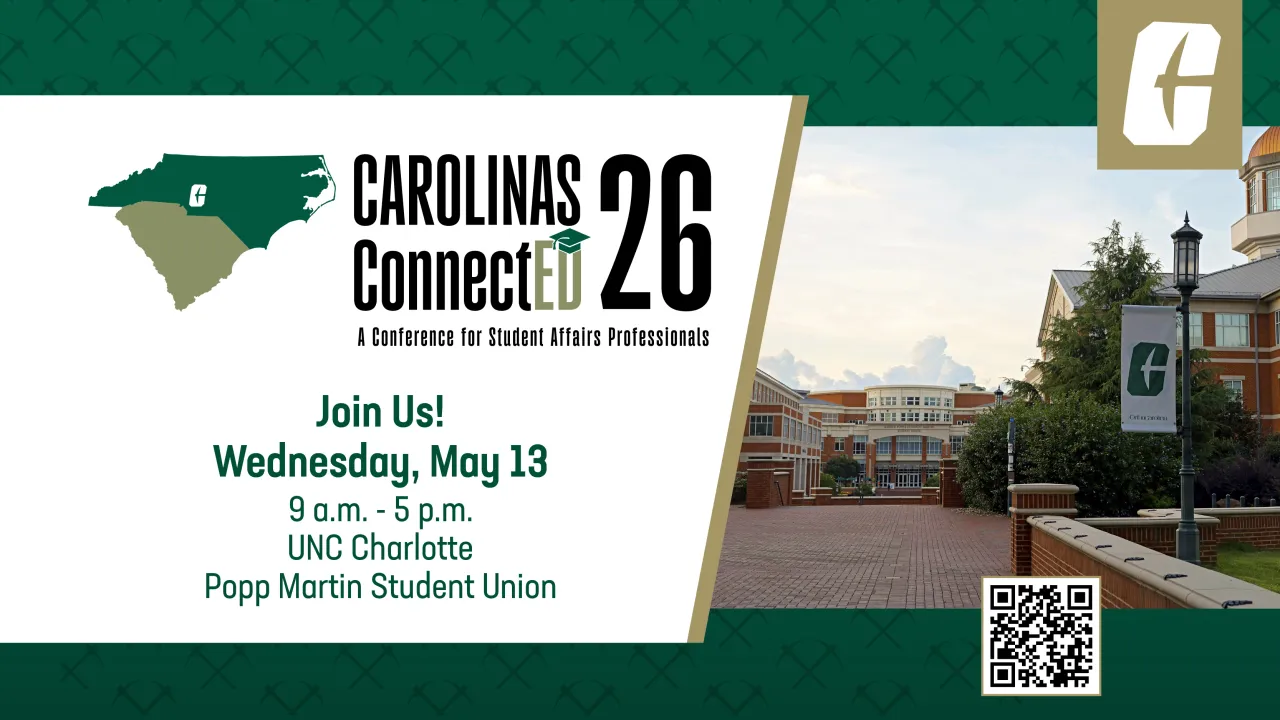
Thank you to over 100 attendees for making this year's Carolinas ConnectED a success!
UNC Charlotte hosted Carolinas ConnectEd on Wednesday, May 13 in the Popp Martin Student Union. The conference, originally known as CLT ConnectED, was first launched and hosted by Charlotte in 2019.
The purpose of Carolinas ConnectEd is to be a catalyst to transformative change by fostering a culture of innovation and collaboration among colleges and universities, driving collective progress and enriching the educational landscape for the benefit of our community and beyond.
If you have questions, contact chair of the Carolinas ConnectEd committee, Emily Teitelbaum, at eteitelb@charlotte.edu.
Conference agenda
9:00 AM - 9:45 AM Check-In & Breakfast
Popp Martin Student Union (PMSU) 340
9:45 AM - 10:30 AM Welcome and Keynote Speaker
Popp Martin Student Union 340
10:40 AM - 11:30 AM Program Session 1 - See Descriptions Below
Various PMSU meeting rooms
11:40 AM - 12:30 PM Program Session 2 - See Descriptions Below
Various PMSU meeting rooms
12:40 PM - 2:00 PM Lunch
Popp Martin Student Union 340
1:40 PM - 2:00 PM Optional Union Tour
Popp Martin Student Union
2:10 PM - 3:00 PM Program Session 3 - See Descriptions Below
Various PMSU meeting rooms
3:10 PM - 3:50 PM Interest Area Roundtables
Popp Martin Student Union 340
3:50 PM - 4:00 PM Closing Remarks
Popp Martin Student Union 340
4:00 PM - 5:00 PM Social
PMSU Norms + Back Patio

Arin Patterson is a leadership strategist and culture architect with over a decade of experience developing people and teams in mission-driven organizations. She serves as the Senior Associate Director of the Popp Martin Student Union at UNC Charlotte, leading a team of more than 100 staff and driving learning and leadership development initiatives. As an industrial organizational psychologist, TEDx speaker, and host of the Arin It Out podcast, Arin has facilitated large-scale educational and leadership events and presented to audiences of more than 500 at conferences, nonprofit and community organizations, and universities. She cares not just about the technical side of management, but the practical behaviors that help leaders create thriving teams.
Program Sessions
From Manager to Multiplier: How Leaders Unlock Potential
Presenter: Arin Patterson, UNC Charlotte
PMSU 200
Are you multiplying your team’s potential or limiting it? Let's explore the difference between “managers” and “multipliers” and how your leadership style directly impacts team performance, ownership, and growth. Walk away with simple, actionable strategies to unlock the full potential of the people you lead.
Scroll, Like, Engage: Turning Campus Social Media into a Student Success Tool
Presenter: Rogelio Nunez, UNC Charlotte
PMSU 267
In today’s digitally connected campus environment, social media is no longer just a marketing tool, it is a critical engagement strategy for student affairs professionals. This interactive session explores how campus offices can intentionally leverage platforms like Instagram, TikTok, and LinkedIn to foster connection, increase student engagement, and support student success.
Participants will learn practical strategies for creating authentic, and student-centered content while aligning social media efforts with institutional goals. Through real-world examples, attendees will gain insight into building meaningful online communities, responding effectively to student needs, and using analytics to inform practice.
Whether you’re managing an established account or just getting started, this session will provide actionable tools to transform your office’s social media presence from passive posting to purposeful engagement.
Connecting with Compliance in 2026: How Compliance Should Inform Student Service Design
Presenters: Lyda Costello Kiser and Nicholas Kehrwald, USC-Upstate
PMSU 265
Three of the top eight issues within Student Affairs involve re-imagining student affairs structures, institutional-wide collaborations, and regulatory compliance (NASPA, 2025). As the floor of what institutions should be doing, compliance should inform institutional student service design. Through compliance data and trends, institutions can better serve students and better protect the institution. The presenters will use [3-5] examples of trend data to demonstrate the intersection between compliance and student service design.
From Conduct to Connection: A Collaborative Model for Student Development
Presenters: Ti-Ana Pyatt and Christopher Davis Jr., Clemson University
PMSU 263
This session highlights a collaborative initiative between the Office of Community and Ethical Standards and the Center for Student Leadership and Engagement at Clemson University that transforms low-level conduct violations into restorative, educational opportunities. Through structured peer and staff engagement, students develop leadership skills, strengthen their campus connections, and reflect on ethical decision-making. Learn how this innovative sanction model promotes student growth while fostering cross-departmental collaboration.
Facing Retirement and What Is Next
Presenter: Aaron Lucier, USC Upstate
PMSU 262
As higher education professionals, we pour decades into supporting students, building teams, and sustaining our institutions. But do we stop to plan for what happens when our professional chapter begins to close—or unexpectedly reopens. This breakout session explores the emotional, professional, and personal dimensions of retirement from student affairs, including identity shifts, opportunities for continued engagement, and practical strategies for planning your “what’s next.”
Building Bridges: Keeping Teams Connected Through Staff Transitions
Presenters: Joe Yavelak and Brigid Casey, UNC Charlotte
PMSU 200
Staff transitions provide a unique opportunity to rethink how we work together across departmental lines. This session explores a collaborative partnership between Housing & Residence Life and Disability Services at UNC Charlotte, demonstrating how team changes can serve as a catalyst for a more unified front. Join us to explore practical frameworks for establishing a strong relational foundation and achieving strategic alignment between offices. You’ll leave with actionable steps for enhancing cross-functional communication, strengthening collaboration, and ensuring your partnerships remain resilient through any season of change.
Changes for Chidsey: Aligning Programming Objectives with Refreshed Learning Outcomes
Presenters: Nadia Campbell and KateLynn Hodgkiss, Davidson College
PMSU 261
Keeping our programming fresh and relevant can be tough. Industry standards state that we should conduct an external review every 7-10 years and an internal review every 5-7 years to meet evolving market needs. Whether your program needs a little refresh or a full internal review, this session will provide suggestions for updating and refreshing program structure to enhance impact. Using the Chidsey Program for Leadership Development, we will walk through programmatic updates as suggested from the last external review, as well as updates made to meet evolving market needs.
Neurodiversity in the Workplace
Presenter: Nic Capano, Davidson College
PMSU 267
We all bring different strengths to our work and they show up in different ways. Neurodiversity is more than a difference of thoughts or a group of labels. This presentation helps clear up misconceptions and provides some accessible ways we can all support Neurodiversity so that everyone's strengths can shine. A rising tide raises all boats. If everyone in the workplace embraces Neurodiversity it will create a better environment for all, especially for those that need it most. I hope this presentation can act as a catalyst for such positive change by sharing helpful information, some of my own experiences as a neurodivergent higher education professional, and a chance to learn from each other.
Title vs. Calling: Reframing Student Leadership Motivation in Higher Education
Presenter: Akio Brown, Newberry College
PMSU 265
Student leadership roles are often positioned as transformative opportunities for engagement, service, and personal development. Yet many students affairs professionals encounter a recurring challenge: students who pursue leadership roles primarily for instrumental reasons - resume building, recognition, or titles - rather than a deeper commitment to community impact or personal growth. This roundtable discussion invites practitioners to examine the motivations behind student leadership engagement and reflect on how these motivations influence both student development and professional practice. Participants will explore the tension between instrumental and purpose-driven leadership, discuss how institutional structures may reinforce resume-driven involvement, and consider how educators can guide students toward more meaningful engagement. Additionally, the session will encourage professionals to reflect on their own sense of vocation and how it shapes their expectations of student leaders. Through collaborative dialogue and shared experiences, participants will leave with new perspectives and practical strategies for fostering intentional leadership development among students.
Transforming Student Accountability: Restorative and Educational Approaches to Student Conduct
Presenters: Shawn McQuillan-Krepps and Mak Tompkins, Davidson College
PMSU 263
Explore how Davidson College is redefining student accountability through restorative, educational, and student-centered practices rooted in the Honor Code and Code of Responsibility. In this interactive community-of-practice session, we’ll tackle the challenges campuses face today—from evolving student expectations and academic integrity concerns to complex community dynamics—and share practical strategies to foster reflection and learning, social responsibility, and community engagement.
From Data to Siloes to Strategic Insight: Building a Student Affairs Data Ecosystem
Presenters: Ellissa Brooks Nelson and Mark Manning, UNC Charlotte
PMSU 262
How can student affairs move from fragmented data to demonstrating measurable impact on student success? This session shares how one institution built a Student Affairs Data Lake—transforming siloed data into a strategic asset that connects student engagement to retention and academic outcomes. Learn practical strategies for building a data ecosystem, engaging stakeholders, and turning insight into action.
Are you a Student Here?": Establishing Authority, Boundaries, and Identity as a New Professional
Presenter: Madison Chaplin, USC-Upstate
PMSU 267
"Are you a student here?"
Many new professionals are faced with this question from students, families, and sometimes their own faculty and staff. The challenges faced by many new professionals in higher education are very unique. You have to lead, supervise, and make the tough calls, all the while trying to find your own professional identity.
This session will explore how early-career professionals can establish credibility, communicate expectations clearly, and set healthy boundaries, without losing their authenticity. Participants will gain practical strategies and real-world language they can apply immediately to strengthen their professional presence.
Learning Beyond the Classroom: Creating and Measuring Student Learning Outcomes Through Collaboration
Presenter: Dr. Alen Doty, South Piedmont Community College
PMSU 265
Attendees will learn the importance of co-curricular learning and identify the benefits of collaboration between academic and student affairs. Learn the importance of learning outcomes in student life, and how to demonstrate student growth and program effectiveness.
Building Quality Community Engagement: Creating Community Collaborators
Presenter: Buck Cooke, USC Upstate
PMSU 263
Everyone has probably heard the phrase “do no harm” in relation to some type of service or community engagement, but, sadly, we often fall short of that basic goal. By attending this session, participants will learn how to build Community Collaborators within an organization’s culture and to use the 9 Components of Quality Community Engagement to create beneficial and appropriate connections with the community.
Fresh Start, New Squad: Navigating Team Transition
Presenters: Jamar Whitfield, UNC Charlotte and Emmy Womble, Davidson College
PMSU 200
Change is inevitable in any workplace setting. From student leaders to professional staff advisors, there is arguably a revolving door of new people to acclimate to your organizational culture and leadership styles. Whether you are brand new to an institution or have new members added to your team, it is important to foster an environment where tradition is honored, but innovation is cultivated. Join us to learn and share ways to navigate successful transitioning amidst institutional and personnel changes on your campus.
The ING in Marketing - An Exploration of Advertising a Leadership Program
Presenters: Nadia Campbell and KateLynn Hodgkiss, Davidson College
PMSU 261
Generating interest in a leadership program requires specificity. How we describe our programs influences the interest generated. The market (our students) needs to know the return on investment or, in other words, the intended outcomes of their participation. Coaching and preparing our students with the necessary language and tools for marketing our program has yielded a higher applicant pool. This session will explore the elevation of marketing efforts implemented by the staff and students of the Chidsey Program for Leadership Development at Davidson College.
The Popp Martin Student Union is located on Craver Road near the intersection of Craver and Cameron Blvd.
Directions to the Popp Martin Student Union from the University Entrance on University City Blvd:
- Continue onto Broadrick Blvd
- At the traffic circle, take the 2nd exit and stay on Broadrick Blvd
- Turn left onto University Rd
- Turn right onto Cameron Blvd
- Front Entrance: Turn right onto Craver Rd. Destination will be on the left.
- Visitor Parking: Continue straight past Craver Rd and turn right onto Student Union Ln to enter visitor parking deck.
Directions to the Popp Martin Student Union from the University Entrance on N Tryon St:
- Continue onto Institute Cir
- At the traffic circle, take the 2nd exit onto Robert D. Snyder Rd
- Turn right onto Phillips Rd
- Front Entrance: Continue onto Craver Rd. Destination will be on the left.
- Visitor Parking: Turn left onto Cameron Blvd. Then turn right onto Student Union Ln to enter visitor parking deck.
Visitor parking is available in the Union Deck. Rates are $5 per hour; $15 max per day (M-F).
Shannon Coleman - Queens University
Tyler Cooper - University of South Carolinas
Kashari Cromer - USC Upstate
Alen Doty - South Piedmont Community College
Heather Harrison - Johnson & Wales University
Bry-Anne Jones - Winthrop University
RJ Kilgore - Johnson & Wales University
Maddie Martin - UNC Charlotte
Shawn McQuillan-Krepps - Davidson College
Brandon Mettler - UNC Charlotte
Arin Patterson - UNC Charlotte
Emily Teitelbaum - UNC Charlotte
Jamar Whitfield - UNC Charlotte
Emmy Womble - Davidson College